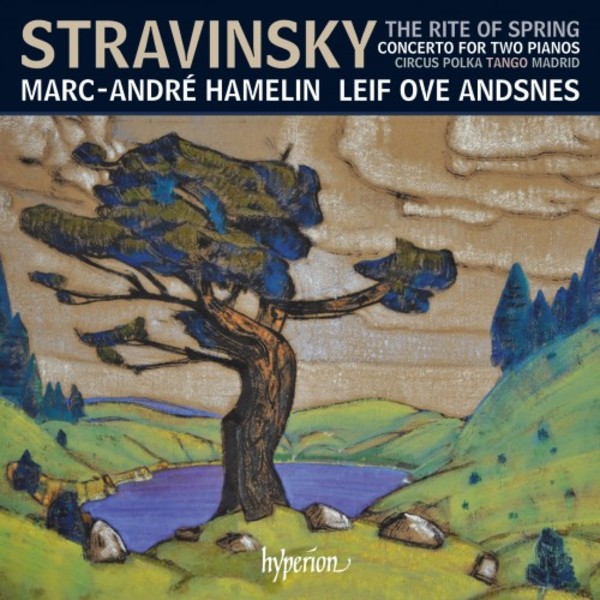
Stravinsky - The Rite of Spring & other works for Piano Duo
£14.20
Usually available for despatch within 5-8 working days
Despatch Information
This despatch estimate is based on information from both our own stock and the UK supplier's stock.
If ordering multiple items, we will aim to send everything together so the longest despatch estimate will apply to the complete order.
If you would rather receive certain items more quickly, please place them on a separate order.
If any unexpected delays occur, we will keep you informed of progress via email and not allow other items on the order to be held up.
If you would prefer to receive everything together regardless of any delay, please let us know via email.
Pre-orders will be despatched as close as possible to the release date.
Label: Hyperion
Cat No: CDA68189
Format: CD
Number of Discs: 1
Genre: Chamber
Release Date: 2nd February 2018
Contents
Works
Circus Polka (arr. Victor Babin for 2 pianos)Concerto for two pianos
Madrid (arr. Soulima Stravinsky)
Tango (arr. for 2 pianos)
The Rite of Spring (Le Sacre du printemps) (piano duet)
Artists
Marc-Andre Hamelin (piano)Leif Ove Andsnes (piano)
Works
Circus Polka (arr. Victor Babin for 2 pianos)Concerto for two pianos
Madrid (arr. Soulima Stravinsky)
Tango (arr. for 2 pianos)
The Rite of Spring (Le Sacre du printemps) (piano duet)
Artists
Marc-Andre Hamelin (piano)Leif Ove Andsnes (piano)
About
Sound/Video
Europadisc Review
Like other performers of the duet version in recent years, Leif Ove Andsnes and Marc-André Hamelin choose to play at separate pianos, thus not only giving one another valuable extra elbow room but also enabling the occasional exchange or even sharing of lines as well as incorporating a myriad of minor but telling modifications to maximise the music’s physical impact. While the account from Jean-Efflam Bavouzet and François-Frédéric Guy on Chandos takes the opportunity to focus on the poetry of the score, Andsnes and Hamelin present a far more visceral account, brilliantly incisive but weighty where needed, with perfectly judged tempi, which builds to thrilling climaxes in both of the ballet’s two parts. Their decision to set opposite rather than alongside one another pays huge dividends, too: just listen to how Andsnes (playing the Primo part to the listener’s left) reinforces the accented chords in the Auguries of Spring (track 2)! Nor do they focus solely on the Rite’s abundant thrills and spills: at the opening of Part 2, where Bavouzet on Chandos chooses the optional tremolo in the right hand part, Andsnes here plays things straight, enhancing the sense of becalmed mystery. His cool-headedness and Hamelin’s energetic virtuosity seem to be mutually infective, drawing the very best out of both players. Their command of detail, coupled with a sure sense of the music’s narrative architecture, takes this performance straight to the top of the pile for those wanting to complement their favourite orchestral recordings of the Rite.
And it’s the coupling that’s decisive here: a stunningly vivid account of the Concerto for Two Solo Pianos (1932-35). Andsnes and Hamelin bring a welcome sense of involvement to the music’s cool neoclassical lines. The first movement positively bursts with energy, while the Notturno second movement has a magical sense of Stravinskian poise wholly absent from the composer’s own 1938 recording with his son Soulima. The concluding Prelude and Fugue is once again perfectly paced and ‘voiced’, clarity and momentum combined in well-nigh perfect balance, with playing of substantial tone that emphasises the composition’s Beethovenian roots. Stravinsky himself might have objected to the palpable expressive commitment of this performance, but his views on his own music were both controversial and frequently changeable: Andsnes and Hamelin not only present a recording for our own time, but one that might well have delighted the old man with its powerful immediacy. It certainly stands head-and-shoulders above all other accounts in the catalogue, and should earn the work many hew admirers.
There are three attractive fillers: Soulima Stravinsky’s four-hand arrangement of Madrid (best known as the fourth of the Quatre études for orchestra of 1928, which seems to send up, among other things, Chabrier’s España), and Victor Babin’s arrangements of the deliciously tart, smoky Tango (1940) and the ever-entertaining Circus Polka (1941-42). This is one of the must-have Stravinsky discs of recent years, and full credit should go not only to the pianists themselves, but to the whole Hyperion team, not least the piano technician Thomas Hübsch, who keeps the Steinway instruments on top form throughout. And how good to see a detail from Nicholas Roerich’s utterly distinctive original set designs for The Rite of Spring on the cover.
Reviews
 Dovetailing seamlessly, with the coordination of a single, four-handed pianist, [Andsnes and Hamelin] bring carefree nonchalance to the complex rhythms of the first part of the Rite. ... The pair plays with tenderness in the central Notturno from the Concerto for two solo pianos, and sparkling finesse in the final Preludio e fuga. ... An intense experience from beginning to end. Eric Worth
 Hamelin and Andsnes are irresistibly clear and energetic, so that the sheer physical excitement is on an altogether higher level. ... the Concerto for two pianos... is Stravinskian neoclassicism at its highest metabolic rate of musical inventiveness: by turns gleefully sardonic and inscrutable, and horribly difficult to bring off. Here my critical pen rests and I reach for my hat. For sheer articulacy, synchronised gymnastics, flawless balance, range of colour and flinty attack, or any other criterion you care to reach for, this is breathtaking pianism. ... a strong candidate for Disc of the Year, never mind of the Month. David Fanning (Recording of the Month)
 There’s no question that Marc-André Hamelin and Leif Ove Andsnes ... represent a sort of pianistic 'dream team' when it comes to music of this difficulty and complexity. Simply put, they turn in a version of The Rite not just technically astounding, but paced and interpreted as well as any of the best full-orchestra performances. ... this interpretation [of the Concerto for Two Pianos] is special because it manages to be precise, that is 'Stravinskian', without ever sounding merely mechanical. David Hurwitz
Error on this page? Let us know here
Need more information on this product? Click here