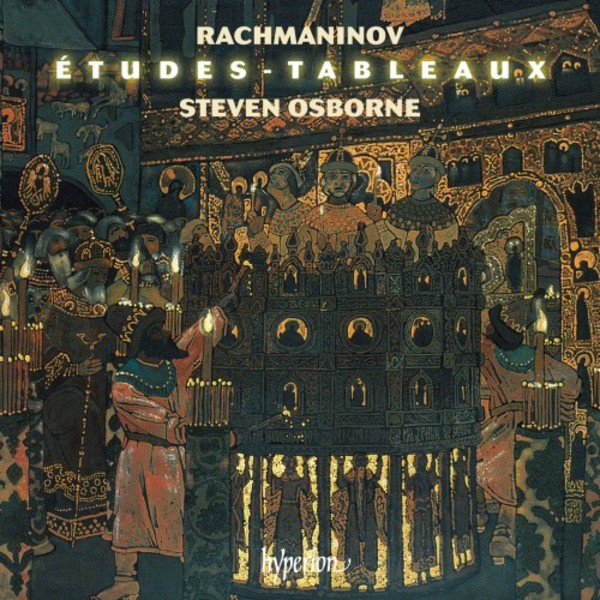
Rachmaninov - Etudes-tableaux
£14.20
Usually available for despatch within 5-8 working days
Despatch Information
This despatch estimate is based on information from both our own stock and the UK supplier's stock.
If ordering multiple items, we will aim to send everything together so the longest despatch estimate will apply to the complete order.
If you would rather receive certain items more quickly, please place them on a separate order.
If any unexpected delays occur, we will keep you informed of progress via email and not allow other items on the order to be held up.
If you would prefer to receive everything together regardless of any delay, please let us know via email.
Pre-orders will be despatched as close as possible to the release date.
Label: Hyperion
Cat No: CDA68188
Format: CD
Number of Discs: 1
Genre: Instrumental
Release Date: 27th July 2018
Contents
Artists
Steven Osborne (piano)About
Sound/Video
Paused
-
1Etudes-Tableaux op.33 - no.1 in F minor
-
2Etudes-Tableaux op.33 - no.2 in C major
-
3Etudes-Tableaux op.33 - no.3 in C minor
-
4Etudes-Tableaux op.33 - no.5 in D minor
-
5Etudes-Tableaux op.33 - no.6 in E flat minor
-
6Etudes-Tableaux op.33 - no.7 in E flat major
-
7Etudes-Tableaux op.33 - no.8 in G minor
-
8Etudes-Tableaux op.33 - no.9 in G sharp minor
-
9Etudes-Tableaux op.39 - no.1 in C minor
-
10Etudes-Tableaux op.39 - no.2 in A minor
-
11Etudes-Tableaux op.39 - no.3 in F sharp minor
-
12Etudes-Tableaux op.39 - no.4 in B minor
-
13Etudes-Tableaux op.39 - no.5 in E flat minor
-
14Etudes-Tableaux op.39 - no.6 in A minor
-
15Etudes-Tableaux op.39 - no.7 in C minor
-
16Etudes-Tableaux op.39 - no.8 in D minor
-
17Etudes-Tableaux op.39 - no.9 in D major
Europadisc Review
Now pianist Steven Osborne, whose recordings of everything from Beethoven, Schubert and Liszt to Debussy, Ravel, Messiaen and Tippett are among the highlights of the Hyperion catalogue (and who has already set down a fine disc of the Rachmaninov Préludes), turns his attention to the Études-tableaux. And, as one might expect of an artist with such formidable technical and musical talents, the results are hugely impressive. Osborne immediately hits his stride with a performance of op.33 no.1 which perfectly nails the contrast between the confident, march-like main theme and the questioning, introverted second theme. Then in the shimmering textures of op.33 no.2 Osborne’s deftness of touch brings to mind the best of his Ravel playing. He brings out the bell-like sonorities of nos. 5 and 7 as surely as he copes with the Presto filigree of no.6 in E flat minor, while his command of the grand rhetorical gestures in no.9 (the last of the op.33 set) is never at the expense of the underlying pulse.
These are performances that put their trust in the score, though never slavishly so. Osborne eschews the more overtly impassioned volatility of, say, Rustem Hayroudinoff (on Chandos), let alone the wilful tempo distortions of Lugansky, preferring a more considered and controlled traversal of these ‘Study-Pictures’. This clear-headed approach pays particular dividends in the op.39 set, where the shifting textures and more adventurous, often Scriabinesque harmonic language are superbly delineated by Osborne. The almost orchestral textures of no.1 in C minor are handled with as much dexterity as the limpid textures of no.2 in A minor, and if the poised Allegro assai of the F sharp minor no.3 feels a shade detached, no such charge could be made for the richly-toned Appassionato of no.5 in E flat minor.
In the best sense, Osborne lets the music ‘speak for itself’; the predominance of minor keys in the op.39 set has never felt less ‘samey’, the contrasts of mood, tempo and texture emerging in a totally unforced manner. And in the final four Études, where Rachmaninov makes some of the most exacting demands on the pianist, Osborne is at the peak of his game. It’s almost as if, by withstanding the temptation to indulge in unmarked tempo fluctuations, he is demonstrating an expressive steeliness and resilience that becomes a hallmark of these readings. The range of touch and dynamic gradation he brings to the lengthy C minor Lento lugubre of no.7 is quite enough, for instance, to keep the listener fully engaged without any histrionic excesses. As for the final two works, in D minor and major respectively, there’s a feeling of cumulative tension and release that is enhanced by Osborne’s patient approach, and that one simply doesn’t get when individual Études-tableaux are excerpted from the cycle.
For those who value a more level-headed approach to Rachmaninov’s music, this compelling disc will be deeply rewarding, with pianisim of astonishing command and sensitivity, and a recording of commendable clarity, focus and warmth. Add to that Geoffrey Norris’s authoritative booklet notes and marvellous cover artwork from one of Nicholas Roerich’s evocatively stylised paintings (Mystery Play in Medieval Novgorod) and you have another impressive addition to Steven Osborne’s ever-expanding Hyperion discography. Marvellous!
Reviews
 Each little gem sounds like the composer at the piano, testing a theme for possibilities, giving it alternate measures of lightness and weight, and then setting it aside to tinker with another passing thought. There is neither ego nor assertion in this account. It is exploratory, improvisatory, analytical, self-critical … [Osborne is] my kind of pianist. Norman Lebrecht
 Steven Osborne’s thrilling new recording leaves no doubt of the Études’ unique position in Rachmaninov’s oeuvre. As brilliant as Osborne’s execution is throughout, it is his freshness of conception that, for me, is most striking. Naturally, every agogic, dynamic and tempo indication is scrupulously observed. ... These interpretations, with shadows of ambiguity, foreboding akin to terror and a profound, tender regret, anchor this music incontrovertibly in its historical moment: the waning of the Russian Silver Age. Rachmaninov fans won’t want to miss this; nor will connoisseurs of intelligent, meaningful piano-playing. Patrick Rucker
 Even in the thorniest and complex passages, Osborne clearly articulates and accents the key notes, bringing them out as if they were landmarks on a road map, and as soon as he's played the first note, he already has the last one in his sights. It's playing on a superior level. I keep listening over and over again to the Op. 39 no. 1 and Op. 39 no. 5 because I can't believe what I'm hearing. The music speaks for itself and becomes a force of its own that pulls you deeper and deeper into Rachmaninov's mind. Jean-Yves Duperron
 Rachmaninov allowed Ottorino Respighi to orchestrate five of these short piano works, providing him with descriptions so specific (sea and seagulls; scene at a fair; an oriental march), you wonder about the silence concerning the rest. It instils the works with a certain mystery, captured imaginatively and authoritatively by Steven Osborne (on Hyperion). As Rachmaninov said, “a small piece can become as lasting a masterpiece as a large work”. Osborne proves his point. Fiona Maddocks
Error on this page? Let us know here
Need more information on this product? Click here