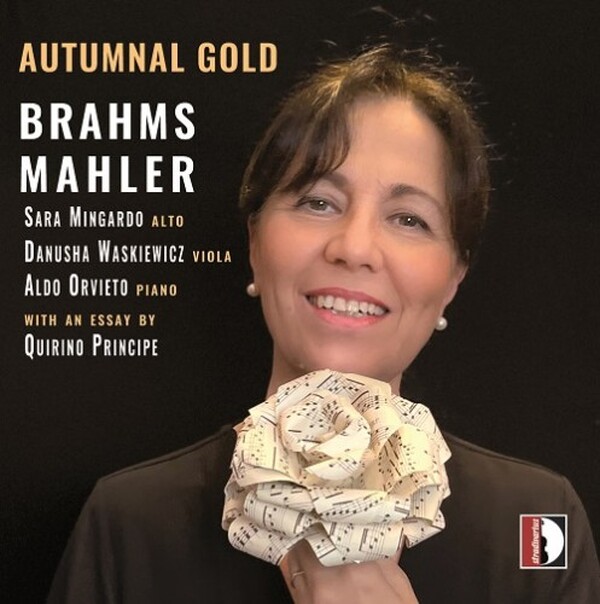
Autumnal Gold: Songs by Brahms & Mahler
£17.05
Despatch Information
This despatch estimate is based on information from both our own stock and the UK supplier's stock.
If ordering multiple items, we will aim to send everything together so the longest despatch estimate will apply to the complete order.
If you would rather receive certain items more quickly, please place them on a separate order.
If any unexpected delays occur, we will keep you informed of progress via email and not allow other items on the order to be held up.
If you would prefer to receive everything together regardless of any delay, please let us know via email.
Pre-orders will be despatched as close as possible to the release date.
Label: Stradivarius
Cat No: STR37155
Format: CD
Number of Discs: 1
Genre: Vocal/Choral
Expected Release Date: 31st December 2026
Contents
Works
Ernste Gesange (4), op.121Gesange (2), op.91 for alto, viola and piano
Lieder (4), op.43
Artists
Sara Mingardo (contralto)Danusha Waskiewicz (viola)
Aldo Orvieto (piano)
Works
Ernste Gesange (4), op.121Gesange (2), op.91 for alto, viola and piano
Lieder (4), op.43
Artists
Sara Mingardo (contralto)Danusha Waskiewicz (viola)
Aldo Orvieto (piano)
About
‘What is more, this particular selection of Lieder, though broad, gravitates around a strong poetic inspiration which, entrusted here to Sara Mingardo, is oriented towards the evocation of moonlit nights, of mysterious nocturnal scents, of that contemplative solitude that quivers between the two extremes of eros and nostalgia. The Lieder of Brahms and Mahler promise cosmic dimensions in the sphere of the sublime. In these, too, the listener also moves, but in ascent or descent: (s)he “moves his (her) steps” not here and there, but into the depths which, when inverted, lead to the heights of heaven, in a sphere almost independent of time and space.
‘At this point our reconnaissance brings us to the music presented for our enjoyment on this CD. Here again, one senses the air and the motion of the passeggiata, of an an easy, informal stroll. This apparently unlikely association is prompted by the metaphorical image of music in the open air as a leisure pursuit, as entertainment. And here is the nub: this image, which implies the idea of “movement” in space and time (the brief space of a public garden, the brief space of a spring afternoon, or that between summer and autumn), takes on much broader ramifications as soon as we establish a logical connection between the democratic social and cultural function of the “Proms” and the mature self-analysis of the kind of lofty, profound music, intimately bound up with a poetic text of similar spiritual level, that was such a feature of Austro-German culture between 1860 and 1914, between the national (or even “nationalistic”) undertones of the said culture and the First World War. The historical parallel is not negligible. Between the phenomenon of the provision of music in a social and urban context – typically but not exclusively British – and an inspiration that can be discerned in the work of two supreme composers who shared the same German language and culture, Brahms and Mahler, we seek to trace an element of continuity. Additionally, we might note, however, how any and every possible concert programme (including every recording and every conceivable form of electronic reproduction) is always a journey, a path; and how music, too, always and in any case, is a language that would not exist if it did not move in space and time, forwards or backwards, towards the “before” or towards the “after”, up into the highest heavens or down into the unfathomable depths, emphasised on occasion by the very notion of walking, as in Musorgsky’s Pictures, or driven by the desperation of a headlong flight from oneself, as in Schubert’s Winterreise.
‘And now, without further ado, let us listen!’
Error on this page? Let us know here
Need more information on this product? Click here