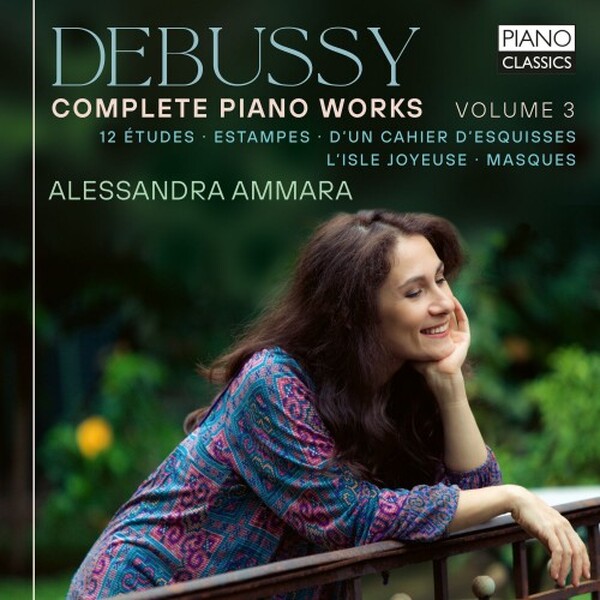
Debussy: Complete Piano Works Vol.3
£15.15
In stock - available for despatch within 1 working day
Despatch Information
This despatch estimate is based on information from both our own stock and the UK supplier's stock.
If ordering multiple items, we will aim to send everything together so the longest despatch estimate will apply to the complete order.
If you would rather receive certain items more quickly, please place them on a separate order.
If any unexpected delays occur, we will keep you informed of progress via email and not allow other items on the order to be held up.
If you would prefer to receive everything together regardless of any delay, please let us know via email.
Pre-orders will be despatched as close as possible to the release date.
Label: Piano Classics
Cat No: PCL10361
Format: CD
Number of Discs: 1
Genre: Instrumental
Release Date: 10th April 2026
Contents
Works
D'un cahier d'esquisses (From a sketchbook), L112Estampes (3)
Etudes pour piano (6), Book 1
Etudes pour piano (6), Book 2
L'Isle joyeuse
Masques
Artists
Alessandra Ammara (piano)Works
D'un cahier d'esquisses (From a sketchbook), L112Estampes (3)
Etudes pour piano (6), Book 1
Etudes pour piano (6), Book 2
L'Isle joyeuse
Masques
Artists
Alessandra Ammara (piano)About
However, it is the 12 Études which have come both to define Debussy's late style – on the piano, as a counterpart to his ballet for Diaghilev, Jeux – and to present both a model and a challenge to later composers of piano études from Tansman to Ligeti. Debussy himself said that they were 'a warning to pianists not to take up the musical profession unless they have remarkable hands'.
While the dry titles of the individual Études serve to conceal their rich and turbulent inner landscape, aspects of their invention are prefigured by the earlier works on Alessandra Ammara’s album. The three movements of Estampes are as much ‘studies’ in their way as the Études – of particular kinds of movement refracted through the images of a Japanese pagoda, a Spanish evening and a garden in the rain. From 1904, and capturing the passion of his affair with Emma Bardac, L’Isle joyeuse references both the island of Jersey and a painting by Watteau, but it also serves as a study in superimposed scales.
Error on this page? Let us know here
Need more information on this product? Click here