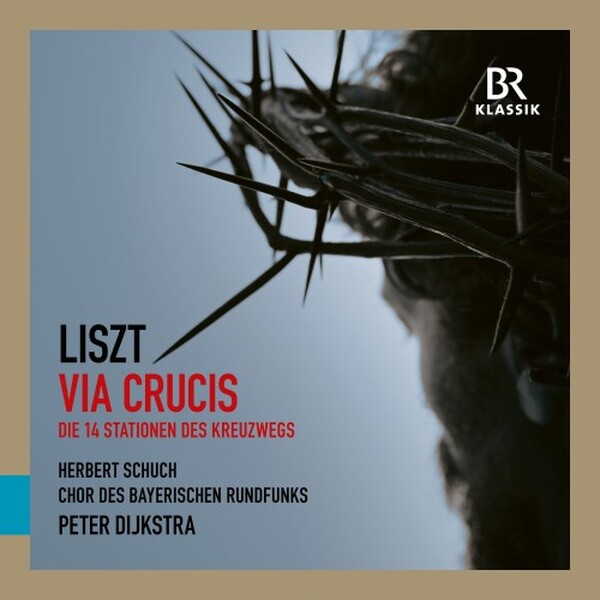
Liszt: Via Crucis
£14.73
Despatch Information
This despatch estimate is based on information from both our own stock and the UK supplier's stock.
If ordering multiple items, we will aim to send everything together so the longest despatch estimate will apply to the complete order.
If you would rather receive certain items more quickly, please place them on a separate order.
If any unexpected delays occur, we will keep you informed of progress via email and not allow other items on the order to be held up.
If you would prefer to receive everything together regardless of any delay, please let us know via email.
Pre-orders will be despatched as close as possible to the release date.
Label: BR Klassik
Cat No: 900534
Format: CD
Number of Discs: 1
Genre: Vocal/Choral
Expected Release Date: 18th September 2026
Contents
Works
Requiem: Seele, vergiss sie nichtRequiem aeternam
Via crucis (The 14 Stations of the Cross), S53
Artists
Chor des Bayerischen Rundfunks (choir)Magdalena Dijkstra (soprano)
Julia Price (soprano)
Merit Ostermann (mezzo-soprano)
Veronika Sammer (mezzo-soprano)
Gabriel Sin (tenor)
Christopher Dollins (baritone)
Michael Mantaj (bass)
Herbert Schuch (piano)
Conductor
Peter DijkstraWorks
Requiem: Seele, vergiss sie nichtRequiem aeternam
Via crucis (The 14 Stations of the Cross), S53
Artists
Chor des Bayerischen Rundfunks (choir)Magdalena Dijkstra (soprano)
Julia Price (soprano)
Merit Ostermann (mezzo-soprano)
Veronika Sammer (mezzo-soprano)
Gabriel Sin (tenor)
Christopher Dollins (baritone)
Michael Mantaj (bass)
Herbert Schuch (piano)
Conductor
Peter DijkstraAbout
Via Crucis, the Way of the Cross, usually comprising fourteen stations of the Passion of Christ – from conviction to death to deposition to burial – has over the centuries been the subject of prayer at the traditional sites in Jerusalem, on pilgrimages, in Catholic churches worldwide, at roadside shrines, in outdoor chapels, and on Calvaries. In composing his version, Franz Liszt mainly had the Good Friday procession in the Roman Colosseum in mind, “in that place whose ground is steeped in the blood of the martyrs”. He wrote his 14 Stations of the Cross for solo voices, choir and organ (originally piano), yet was much taken with the idea of carrying a harmonium into the ruins of the Colosseum for his musical devotions to be sung there too: “I would be happy if those sounds could be heard there that only faintly reflect the inner emotion that overcame me when, on my knees with the devout procession, I more than once repeated the Latin words.” It remained a mere vision, however: his late work Via Crucis was neither rehearsed nor published, and met with firm rejection from the purists from the ultra-conservative Cecilian movement. It was not until fifty years later, on Good Friday 1929, that the work was finally premiered in Budapest.
Liszt was acquainted with the young Peter Cornelius, a multi-talented composer, violinist, actor, poet, librettist and essayist from Mainz. Cornelius had received a thorough grounding in music history, from Palestrina to Bach, when he approached Liszt and the circle of the “New Germans”. In 1852, he wrote a setting of the Introit of the Latin Requiem Mass, Requiem aeternam, in a classically refined style for male choir. That same year, Liszt urged him to “devote himself to church music with the utmost resolve” – advice that Cornelius respectfully declined. His Requiem, composed in 1863, has nothing to do with the Catholic liturgy; Cornelius set to music a poem by the dramatist Friedrich Hebbel: “Soul, do not forget them, soul, do not forget the dead!” – Both of Cornelius’s choral works also feature on this CD.
Error on this page? Let us know here
Need more information on this product? Click here